Prospective Students
At the University of North Dakota, the Department of Atmospheric Sciences provides immersive, cutting-edge meteorological education, and offers unique experiences and opportunities to students in all stages of their careers.
Undergraduate Students
The Four-Year Program at UND meets the recommendations of the American Meteorological Society and the entry requirements of the National Weather Service, while offering a number of features that set UND apart.
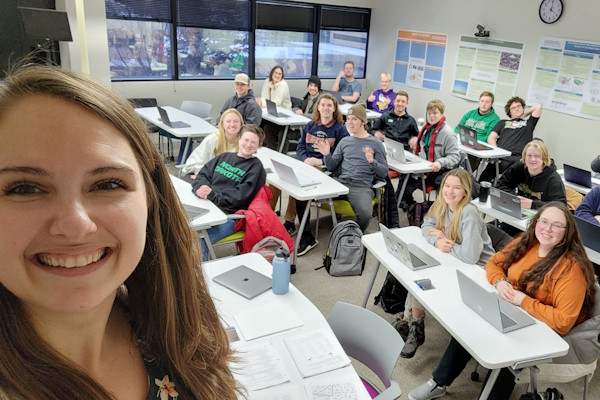
Learn from Leaders in the Field
Our small classes create a welcoming environment where faculty know their students and are invested in their success. At the same time, you'll learn from internationally recognized researchers advancing atmospheric science through work supported by NSF, NASA, NOAA, DOE, and more.
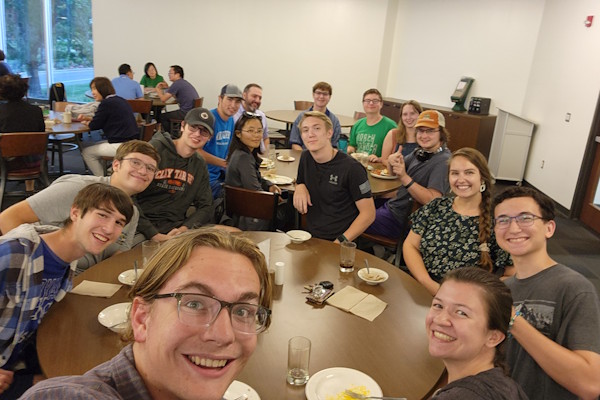
AtSc Living Learning Community (LLC)
The LLC is open to any incoming student, and helps students build a sense of belonging early in their undergraduate experience, while providing opportunities for connections with fellow Atmospheric Sciences students.
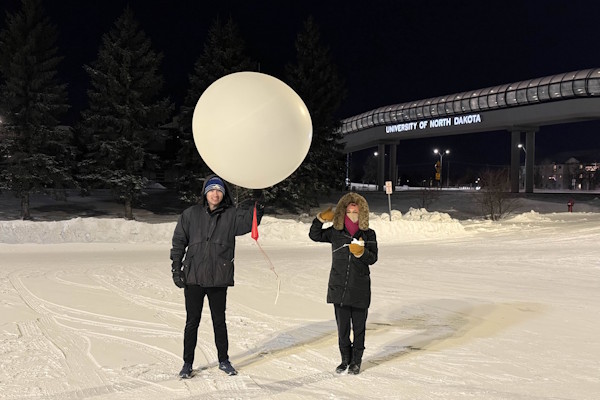
Department of Atmospheric Sciences faculty are actively performing research for a variety of government agencies and private companies.
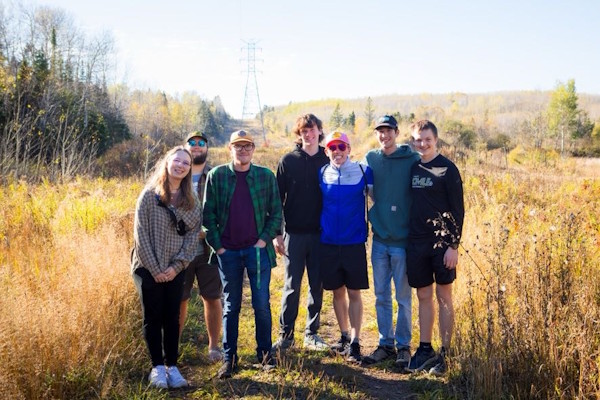
Our students are heavily involved across UND and have access to multiple experiential learning opportunities, including UND WxUpdate, our student-run weather broadcast organization.
Graduate Students
Gain deep expertise in atmospheric sciences and lead the way in tackling the challenges of understanding and predicting our atmosphere.
Graduate Assistantships
Graduate assistantships are available on a competitive basis to qualified graduate students in the Department of Atmospheric Sciences. These assistantships provide an employment opportunity for students to help defray the costs of education and provide work experience within the field. These assistantship positions are also generally accompanied by tuition waiver support. Assistantships may be awarded for teaching (GTA) or research (GRA) activities. GRAs are provided by faculty through external grant funds that support the faculty member's research. The work performed under a GRA may or may not be aligned with the thesis topic of the student, depending on the match between the student's interest and her/his advisor's needs. Additional information regarding graduate assistantships may be found at the School of Graduate Studies.
Faculty Research Areas
Department of Atmospheric Sciences faculty are actively performing research for a variety of government agencies and private companies.
| Name | Research Areas |
|---|---|
| Jake Carstens | hurricanes, tropical convection, climate modeling, broadcast and digital meteorology |
| Jordan Christian | subseasonal-to-seasonal weather and climate extremes, utilizing a combination of reanalysis data, satellite observations, and climate models |
| Mounir Chrit | trustworthy artificial intelligence, mesoscale and microscale weather forecasting, environmental solutions for advanced air mobility, guidance to regulations on UAS integration, data assimilation, tropospheric chemistry and aerosol modeling |
| David Delene | air pollution, atmospheric aerosols, climate change, cloud physics, satellite remote sensing of aerosols and clouds, weather modification |
| Montana Etten-Bohm | lightning parameterizations, geoscience education |
| Matt Gilmore | cloud physics, cloud microphysics parameterization, cloud-scale modeling, lightning, radar meteorology, severe and hazardous weather, supercell and tornado dynamics, intercomparison techniques between observations and models |
| Aaron Kennedy | mesoscale meteorology and modeling, winter weather and convective storms, in situ observations, remote sensing, UAS |
| Marwa Majdi | fog and cloud microphysics, atmospheric aerosols, aerosol chemistry and mixing state weather, forecasting, weather for uncrewed aircraft systems, machine learning for weather prediction |
| Jared Marquis | data assimilation, remote sensing, radiation, agricultural weather |
| Daile Zhang | atmospheric electricity, upper troposphere and lower stratosphere, remote sensing, atmospheric instrumentation, severe storms, cloud physics, natural hazards and safety |
| Jianglong Zhang | aerosols and clouds, radiation and remote sensing, data assimilation, climate and agriculture |