
Research
UND's commitment to weather and related research took off in 1974 when the school acquired its first weather radar system with support from the U.S. Bureau of Reclamation and the National Science Foundation. This also led to the eventual creation of the Department of Atmospheric Sciences. The radar was used as part of a training program for weather modification pilots and also to collect data for weather modification projects. These core areas of education and research continue in the department today.
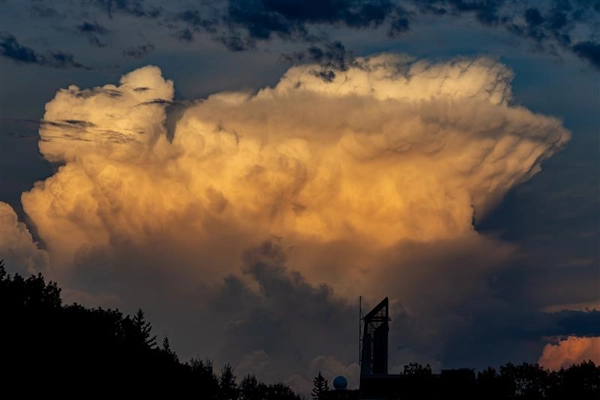
Cloud physics is the study of the physical processes that cause clouds to develop, grow, and precipitate.
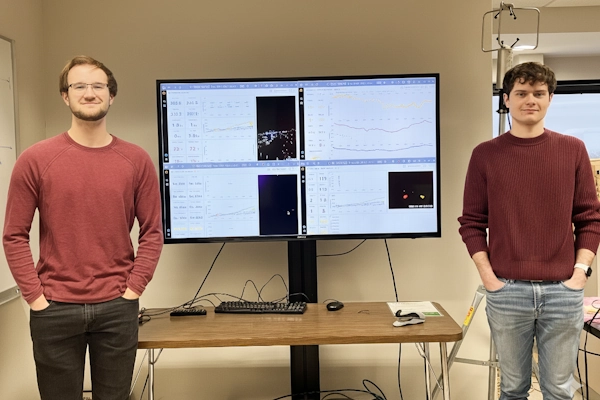
We help students learn the full data workflow using real datasets: collect, clean, analyze, visualize, document, and communicate results.
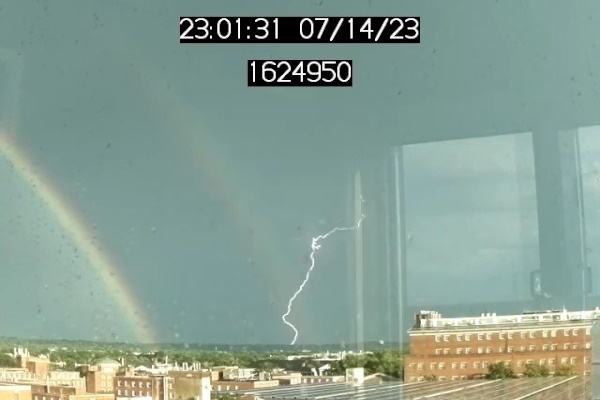
Lightning and Atmospheric Electricity
Global lightning activity is studied due to its impacts on weather, climate, infrastructure, and natural disasters.
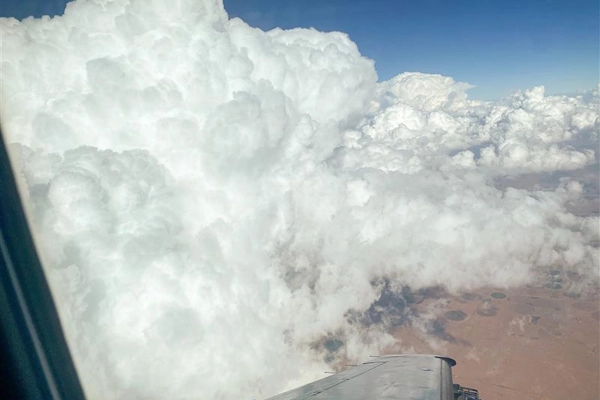
Cloud seeding is a weather modification technique generally employed to enhance precipitation or reduce hail.
Learn about how to add your research to this website.
Faculty Research Areas
Department of Atmospheric Sciences faculty are actively performing research for a variety of government agencies and private companies. Undergraduate students are hired to help with data analysis and other research tasks on these research grants. This will give you a chance to learn how research is conducted and whether a career path in research would be right for you.
-
Matthew Brown: severe storm dynamics and predictability, mesoscale meteorology, numerical modeling, convective risk and impacts
-
Jake Carstens: hurricanes, tropical convection, climate modeling, broadcast and digital meteorology
-
Jordan Christian: subseasonal-to-seasonal weather and climate extremes, utilizing a combination of reanalysis data, satellite observations, and climate models
-
Mounir Chrit: trustworthy artificial intelligence, mesoscale and microscale weather forecasting, environmental solutions for advanced air mobility, guidance to regulations on UAS integration, data assimilation, tropospheric chemistry and aerosol modeling
-
David Delene: air pollution, atmospheric aerosols, climate change, cloud physics, satellite remote sensing of aerosols and clouds, weather modification
-
Montana Etten-Bohm: lightning parameterizations, geoscience education
-
Matt Gilmore: cloud physics, cloud microphysics parameterization, cloud-scale modeling, lightning, radar meteorology, severe and hazardous weather, supercell and tornado dynamics, intercomparison techniques between observations and models
-
Aaron Kennedy: mesoscale meteorology and modeling, winter weather and convective storms, in situ observations, remote sensing, UAS
-
Marwa Majdi: fog and cloud microphysics, atmospheric aerosols, aerosol chemistry and mixing state weather, forecasting, weather for uncrewed aircraft systems, machine learning for weather prediction
-
Jared Marquis: data assimilation, remote sensing, radiation, agricultural weather
-
Puja Roy: cloud physics, high-resolution cloud microphysical process modeling (particle-based, direct numerical simulations, large eddy simulations), microphysical parameterizations, aerosol-cloud-radiation interactions, cloud electricity, in-situ observations, science outreach and education, science policy
-
Daile Zhang: atmospheric electricity, upper troposphere and lower stratosphere, remote sensing, atmospheric instrumentation, severe storms, cloud physics, natural hazards and safety
-
Jianglong Zhang: aerosols and clouds, radiation and remote sensing, data assimilation, climate and agriculture