Space Operations Group
The Space Operations Group, or SOG, is a research group formed in 2022 within the Department of Space Studies, located in Clifford Hall. This group focuses on satellite mission operations, aerospace mission concept development, and stratospheric ballooning. Current research topics include on-orbit docking, doppler tracking, and space and upper atmosphere radio communications. SOG operates the Odegard Ground Station (OGS) and the Mobile Ground Station (MGS). OGS is being developed to support the ROADS mission. MGS is adjacent to the Inflatable Lunar-Mars Analog Habitat and has been used to support Doppler tracking research. The local amateur radio community also utilizes MGS for events.
In addition to the lab in Clifford Hall and the various ground stations, SOG manages the Space Operations Center (SpOC), a new classroom designed to support satellite mission operations. SpOC will ultimately allow UND to control satellite missions through the OGS via remote connection. SOG is working with Added Value Solutions (AVS) on ROADS, which is North Dakota's first satellite mission. SOG is actively participating in the University of Louisiana-Lafayette's CAPE-IV mission by integrating and operating a communications payload built by AMSAT for this satellite. SOG is also working with AMSAT on the development of a digital space-borne repeater, PACSAT. SOG consists of faculty, staff, and graduate and undergraduate students.
Alumni in Industry
Alex Blumenthal
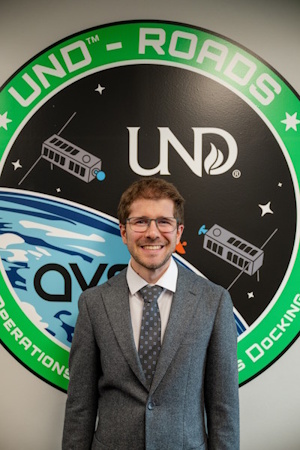
I began working with Dr. Fevig in the fall of 2022 when I started my MS in Space Studies. As the first student member of SOG, I initially conducted research into Doppler tracking and satellite ground stations, then transitioned into the role of Program Manager as more students joined the group. I developed an interest in radio communications and ground systems while also learning about space mission design and high-altitude ballooning.
I will soon be joining Infinity Systems Engineering as a Space Systems Operator in Grand Forks. I'm excited to see the local area grow in terms of space infrastructure, space jobs, and networking opportunities for students and professors. I hope to mentor other UND students and act as a bridge between the university and the local space industry.
What I find fascinating about how the Space Operations Group has grown over time is the diversity of backgrounds of our members. We've had students in Space Studies, Chemistry, Math, Physics, EE, Aviation, and other programs across the university. Every day we're proving that we can take students from a variety of educational backgrounds, as long as they have a strong interest in space, and ultimately develop them into technical experts in space operations and other fields of aerospace.
I'm proud of all the work that our members have accomplished thus far, and I can’t wait to see what they do in the future and how the group will evolve over time.