Space Studies Symposium 2026
Friday, March 27
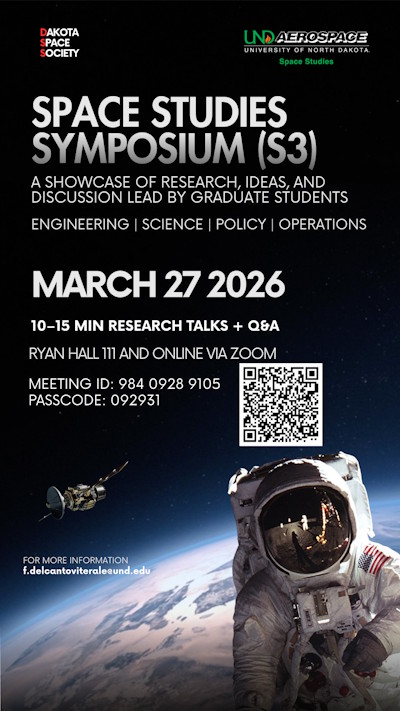
Participants will prepare a short oral presentation that summarizes their overall project through its research questions, methods, and conclusions. During the session, presenters will introduce and explain their project to the audience and answer questions.
Overview
- Format: Oral presentations (10-15 minutes) followed by a 10-minute Q&A
- Date: Friday, March 27, 2026
- Location: Ryan Hall 111 and Online via Zoom
- Audience: Space Studies faculty, graduate students, and invited guests
- Organizers: Department of Space Studies, Dakota Space Society (DSS)
Goals
- Create a research forum for students and professors within the Department of Space Studies
- Stimulate intellectual exchange and engage in discussions to share ideas and explore new research directions and emerging trends
- Promote scholarly work showcasing the research and creative achievements of faculty and students
- Develop presentation and oral communication skills, and gain experience in preparing and presenting research in a professional setting
- Gain feedback to refine students' research, and learn about different methodologies and approaches
- Get a broader understanding of the research being conducted by peers and other students
- Share and disseminate research, presenting research projects to a wider audience and getting feedback from peers and experts
Schedule
| Time | Event |
|---|---|
| 8:30 a.m. | Opening Words Professor Del Canto Viterale |
| 8:35 a.m. | Chair's Remarks Professor de León |
| 8:40 a.m. - 9:00 a.m. | Presentation/Q&A #1 "Proof-of-Concept Demonstration of RL-Based Reactivity Control for Nuclear Thermal Propulsion System" by Susmitha Guddanti |
| 9:00 a.m. - 9:20 a.m. | Presentation/Q&A #2 "From ISS To Commercial Space Stations: Managing Public-Private Partnerships in the New Space Age" by Matias Tolone |
| 9:20 a.m. - 9:40 a.m. | Presentation/Q&A #3 "Microbial Airborne Simulation and Measurements for Mars (MIASMMA): Development of novel methods for a study to constrain planetary protection risk for crewed exploration" by Pranika Gupta |
| 9:40 a.m. - 10:00 a.m. | Presentation/Q&A #4 "Niobium-Enhanced Regolith Concrete for Lunar and Martian Construction Applications" by Nicolas Padovani |
| 10:00 a.m. - 10:20 a.m. | Presentation/Q&A #5 "Reinforcement Learning Controlled Hypersonic Mars Lander Descent Using a Physics-Based Python Simulation" by Naimul Hasan |
| 10:20 a.m. - 10:40 a.m. | Presentation/Q&A #6 "Wartime Innovation at the Commercial-Military Nexus: Lessons for Future Space Conflict" by Averi Richert |
| 10:40 a.m. - 10:50 a.m. | Break |
| 10:50 a.m. - 11:10 a.m. | Presentation/Q&A #7 "LAMP: Long-duration Analogue Microbiology Program at Haughton as a Mars-Class Biosignature Testbed" by Terry Trevino |
| 11:10 a.m. - 11:30 a.m. | Presentation/Q&A #8 "Devising a Cybersecurity Education for Building, Constructing, and Integrating University Small Satellites" by Rachel Jones |
| 11:30 a.m. - 11:50 a.m. | Presentation/Q&A #9 "Human Settlement - Where ever it is" by Joshua Carlson |
| 11:50 a.m. - 12:10 p.m. | Presentation/Q&A #10 "Fitness for Duty Prediction from Body Battery Sleep Deprivation Measurements" by Joseph Clift |
| 12:10 p.m. - 12:30 p.m. | Presentation/Q&A #11 "Non-terrestrial construction using novel in-situ biochemical 3d printing with Martian and lunar regolith" by Jurie Visagie |
| 12:30 p.m. - 12:50 p.m. | Presentation/Q&A #12 "Evaluating Anthropocentric Information Capacity of Global Open-Source Satellite Remote Sensing" by Jeffrey Kreiner |
| 12:50 p.m. | Closing Words Professor Fernandez-Tous |