
Flying Team
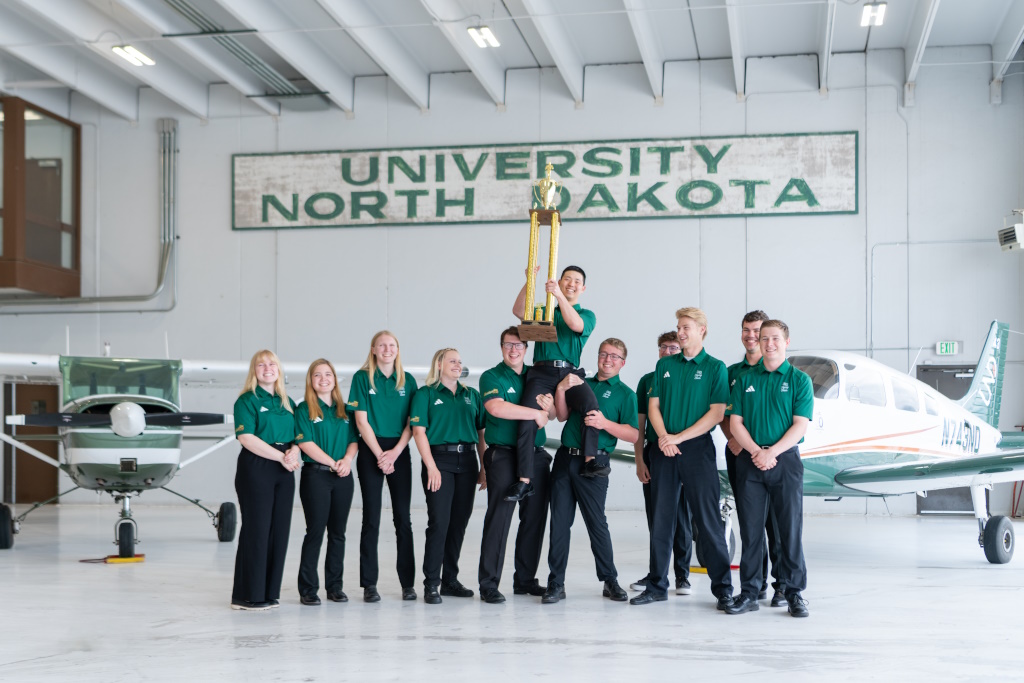
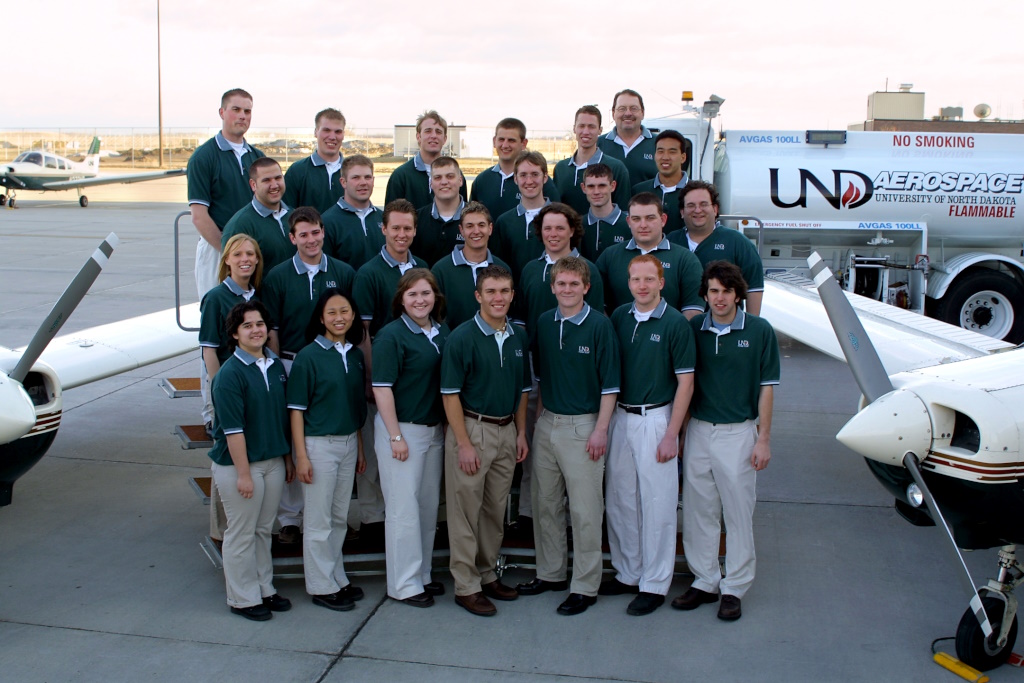
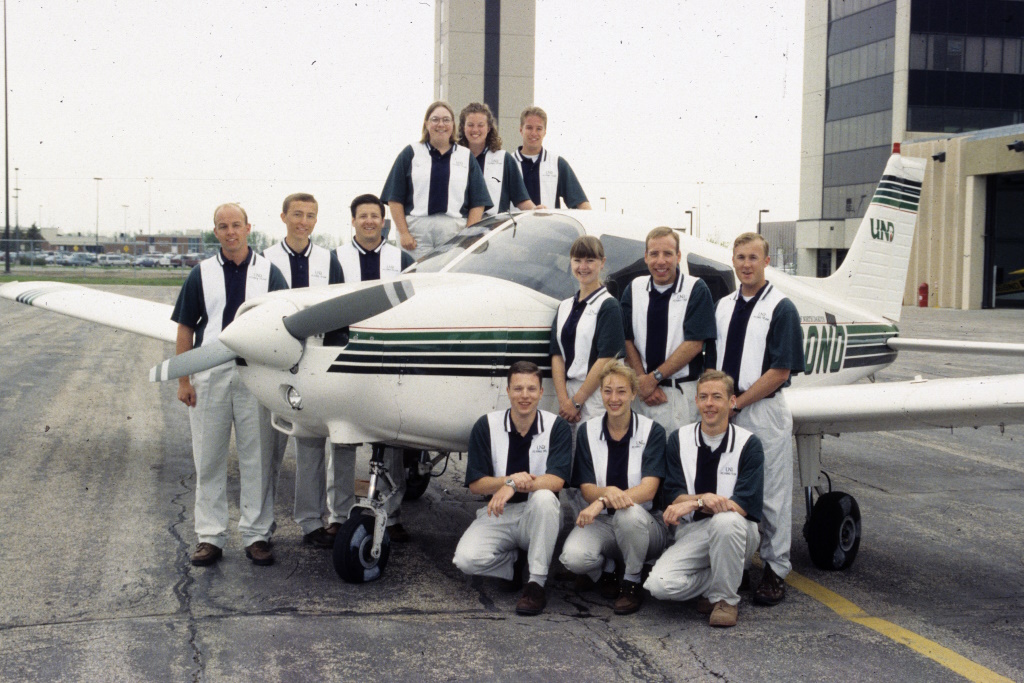
Year after year, the UND Flying Team has set the standard for collegiate competition flying.
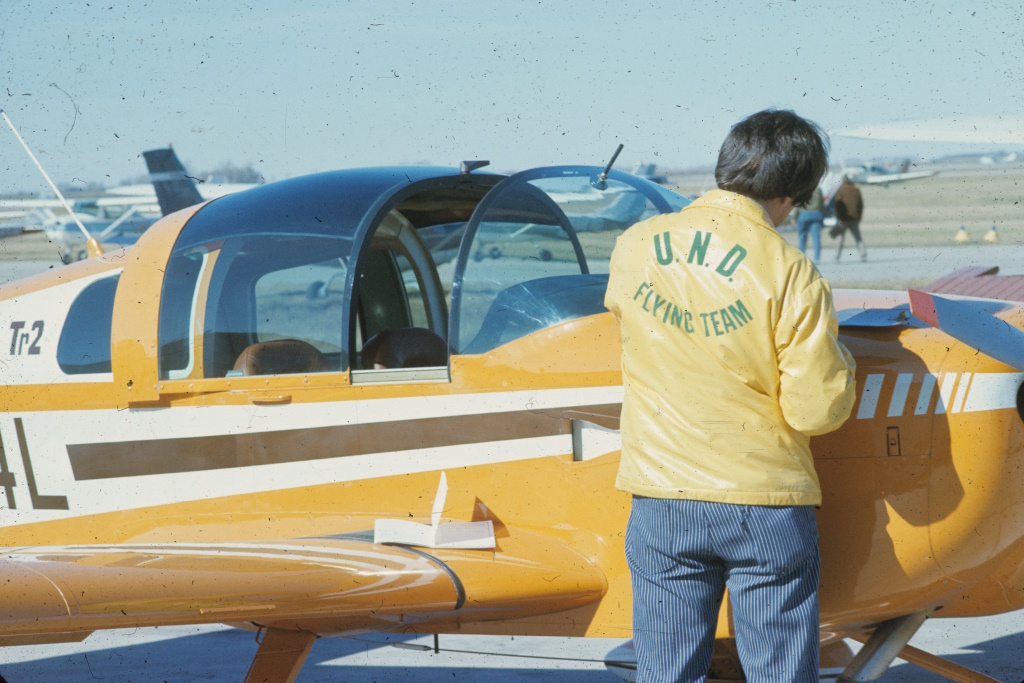
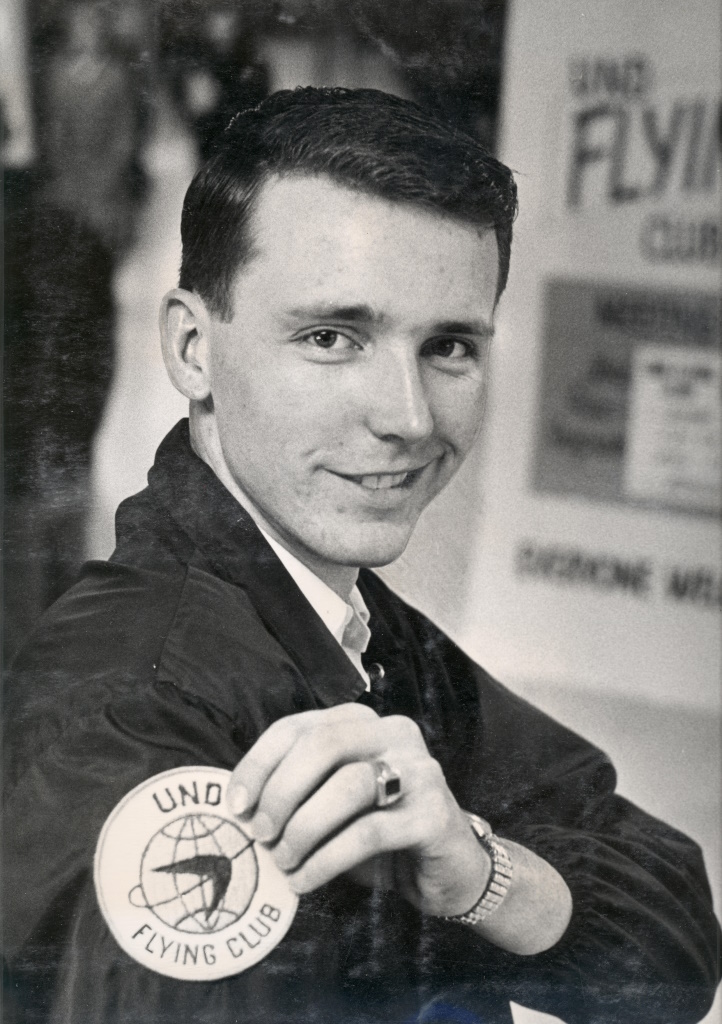
Established in 1966, the UND Flying Team competes under the National Intercollegiate Flying Association (NIFA) at regional and national competitions. The team, made up of students and faculty, competes in numerous ground, simulator, and flying events throughout the year. Aviation students at the University of North Dakota are eligible to join even before they obtain a private pilot certificate. The team is always looking for new members who are ready to continue their winning tradition!
Competitions
There are two competitions every year: the regional competition, and the national competition. The Flying Team competes in the Region IV competition, usually hosted in the fall around mid-semester. Different schools host the competition every year, providing unique travel opportunities.
Upon invitation, the Flying Team also competes in the national competition (SAFECON) alongside over 30 other schools from around the country. This competition is usually hosted in May at the end of the semester. Like the regional competition, the location for SAFECON varies every year.
Flight Events
Short-Field Landings
Each contestant shall make a certain number of landings, flying a rectangular pattern. Abeam the landing site, the contestant shall pull power and perform a short field landing. Once power is pulled, it can not be added back and the landing must be made in a full stall attitude. The pilot shall land on the designated line with a tolerance of 100 feet short and 200 feet long.
Power-Off Landings
Each contestant shall make a certain number of landings, flying a rectangular pattern. Abeam the landing site, the contestant shall pull power to idle and land on the designated line with a tolerance of 100 feet short and 200 feet long.
Unlimited Navigation
In the unlimited category, the flight planning may be completed using any equipment that meets FAA standards for primary use in flight planning and enroute VFR navigation. The contestant may be required to prove aeronautical data currency on the device to be used.
The UND Flying Team uses the Piper Archer for this event.
Traditional Navigation
In the traditional category, the flight planning must be completed using only a current NOAA sectional chart. Multiple charts may be taped or stapled together, but it is the contestant's responsibility to prove chart currency. Flight computers and calculators may also be used in planning. Use of any automated flight planning software is prohibited.
The UND Flying Teams use the Cessna 150 for this event.
Message Drop
In message drop, contestants are to drop a container from an aircraft no lower than 200 feet. There shall be two targets at either end of the runway for contestants to try and hit. The distance from the targets added together are the score.
Ground Events
Computer Accuracy
Computer accuracy, or compacc, consists of several questions answered using a manual flight computer. The problems include questions based on time, speed, distance, wind corrections, fuel requirements, conversion factors, and much more!
Simulated Comprehensive Aircraft Navigation
Simulated comprehensive aircraft navigation is an event with problems related to a simulated cross-country flight over a given route. Included in the flight planning are questions on weight and balance, aircraft performance, federal regulations, aeronautical charts, weather interpretations, and fuel consumption.
Aircraft Recognition
During aircraft rec, competitors are shown slides of an aircraft and are given 15 seconds to identify the aircraft manufacturer, model number, and official name, if it has one.
Ground Trainer
In Ground trainer, or sim, contestants are given an instrument pattern to fly based solely off reference to instruments. The event is scored based on the accuracy of the contestant.
Preflight
In preflight, an aircraft is "bugged" with at least 30 unairworthy discrepancies. Competitors are then given 15 minutes to preflight the aircraft and find as many of the discrepancies as possible.
Crew Resource Management/Line Oriented Flight Training
In CRM/LOFT, contestants are given a scenario that will be planned with an even and realistic mix of simple problems (e.g. one navigational radio failing) and complex situations (e.g. one of three landing gear not extending). The event is designed to test the contestants' ability to work together to solve realistic problems.
IFR
In IFR, contestants are to fly a scenario in a simulator that may include any departures, descents, and turns: VOR and NDB tracking, radar vectors, a non-precision approach, a precision approach, a missed approach, and a landing while under simulated IFR. They are to use standard procedures required by the Aeronautical Information Manual (AIM) and Air Traffic Control (ATC).


Frequently Asked Questions
How do I join?
It's as simple as showing up to Odegard Hall Room 360, and speaking with a team member! We will get you more involved from there.
What are the requirements to join?
There are no requirements to join the Flying Team! Anyone from any major may join. There are, however, requirements to compete at competition laid out by the National Intercollegiate Flying Association (NIFA):
- Each contestant must be currently enrolled at the institution the team represents.
- Each contestant may compete in no more than four (4) Regional and four (4) National SAFECONs.
- Each contestant shall be able to show proof of items 1 and 2. If the SAFECON is held after the normal semester, the contestant is considered eligible as if the SAFECON were held during the normal semester.
- Contestants who have accumulated more than 1500 total flight hours are not eligible to compete.
- Contestants who possess a Flight Instructor certificate may compete in a maximum of two (2) Regional and two (2) National SAFECONs after the original issuance date of the certificate.
It is also required to have at least a private pilot license before piloting an aircraft.
Do I need to have a pilot license?
Yes and no. You need at least a private pilot license before you can fly an aircraft. However, that does not stop you from riding along in the aircraft with another pilot, or from competing in our many ground events.
What is the average time commitment?
As much or as little as you determine. We are a team and we have set practice times that we ask you to be at. Improving in your event and becoming competitive takes individual dedication and time. Talk with your event lead for specifics.
What are the benefits of joining?
There are many benefits to joining our team!
- We have an extensive network of alumni that spans throughout the industry. Being on the team unlocks many new connections.
- We are a group of friends, and those friendship last a lifetime.
- We are committed to perfecting our craft and developing our professional piloting skills. As a member of the Flying Team, we will help you develop your skills to become the best pilot you can be.
Competition History
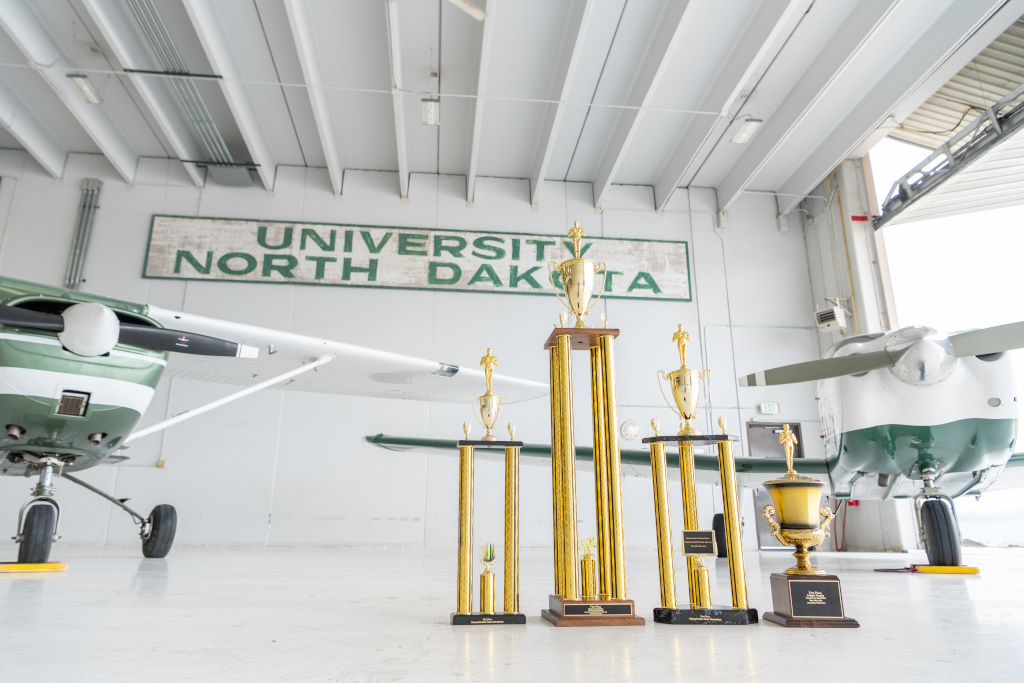
UND took first place at the national SAFECON hosted by the City of Janesville, Wisconsin.
UND took first place at the national SAFECON hosted by the University of Wisconsin in Janesville, Wisconsin.
UND took first place at the national SAFECON hosted by Indiana State University.
UND took first place at the national SAFECON hosted by Parks College of University of St. Louis.
UND took first place at the national SAFECON hosted by Ohio State.
UND took first place at the national SAFECON hosted by Middle Tennessee State University.
UND took first place at the national SAFECON hosted by UND.
UND took first place at the national SAFECON hosted by Delta State.
UND took first place at the national SAFECON hosted by Embry-Riddle Aeronautical University - Daytona.
UND took first place at the national SAFECON hosted by Delta State.
UND took first place at the national SAFECON hosted by Parks College of University of St. Louis.
UND took first place at the national SAFECON hosted by Nicholls State.
UND took first place at the national SAFECON hosted by the University of Illinois.
UND took first place at the national SAFECON hosted by UND.
UND took first place at the national SAFECON hosted by NE Louisiana.
UND took first place at the national SAFECON hosted by Southern Illinois University.
UND took first place at the national SAFECON hosted by the Texas State Technical College.
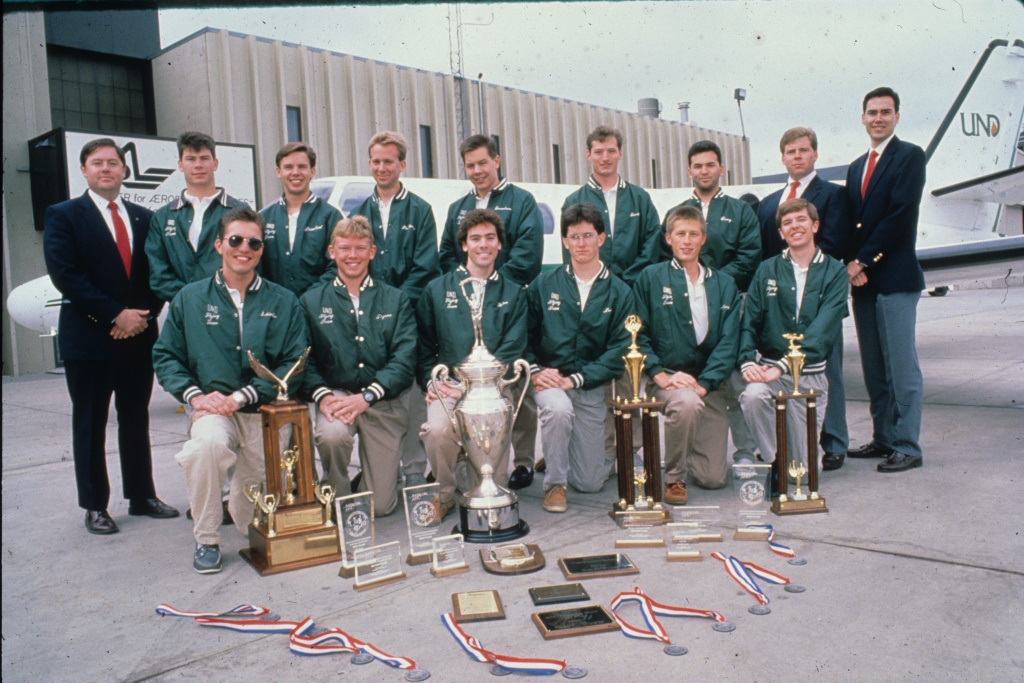
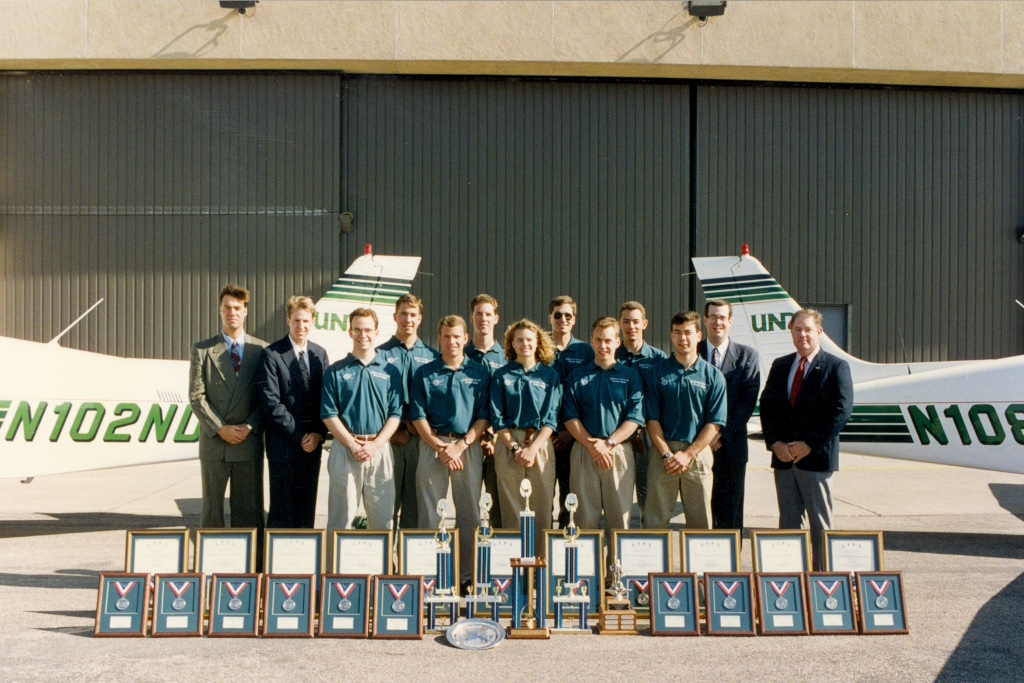
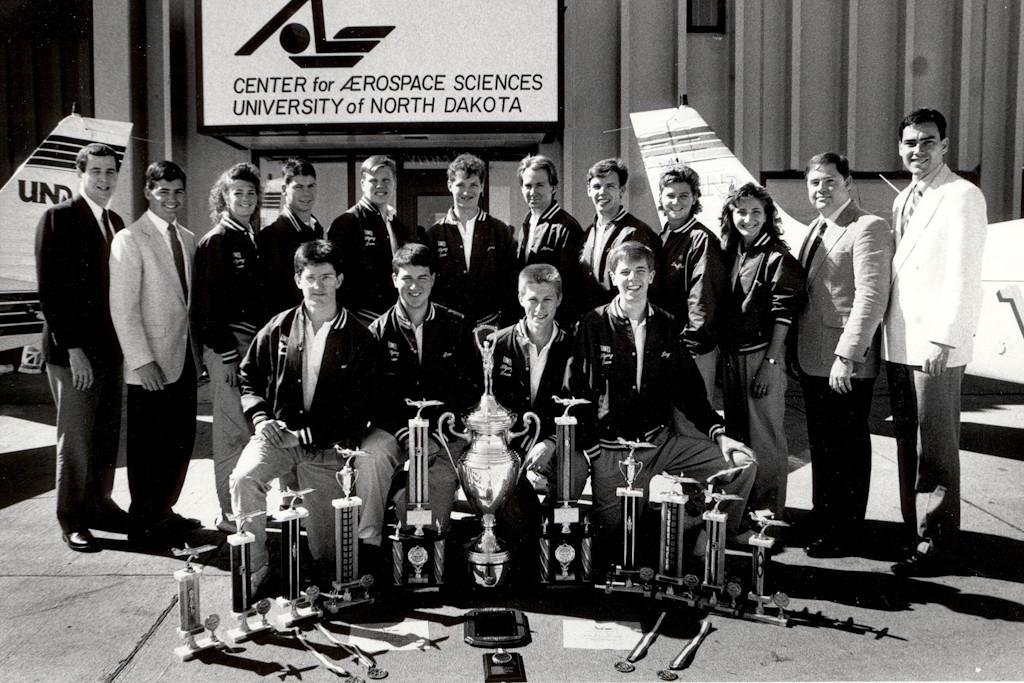
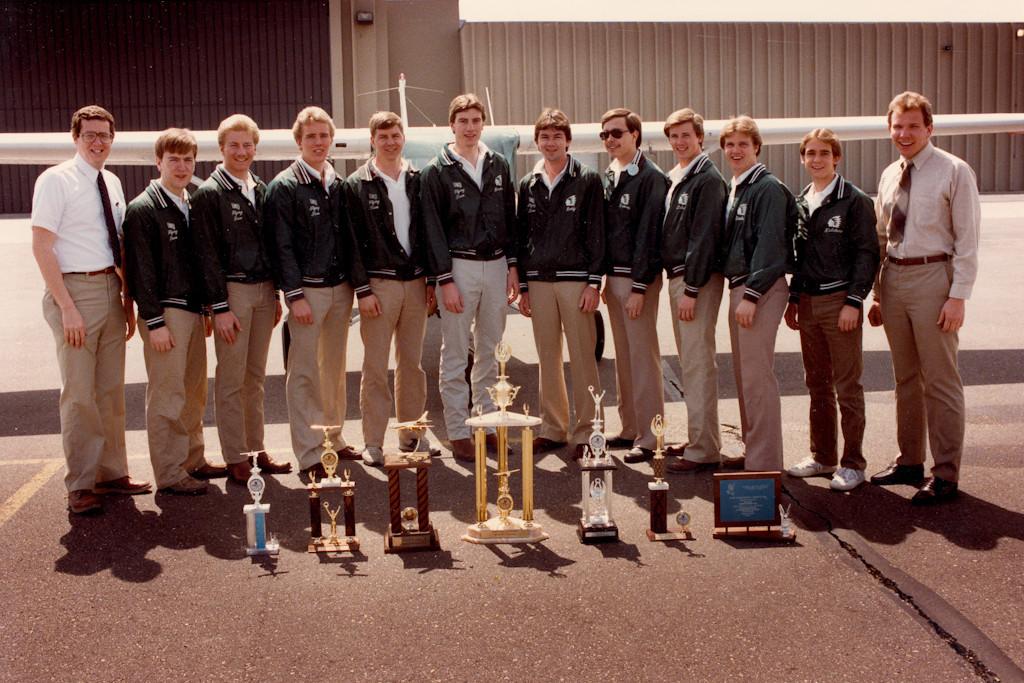
In 1985, under the leadership of Kent Lovelace, the UND Flying Team won its first National Championship. The first victory started a series of unmatched successes as the team went on to win seven consecutive national championships.